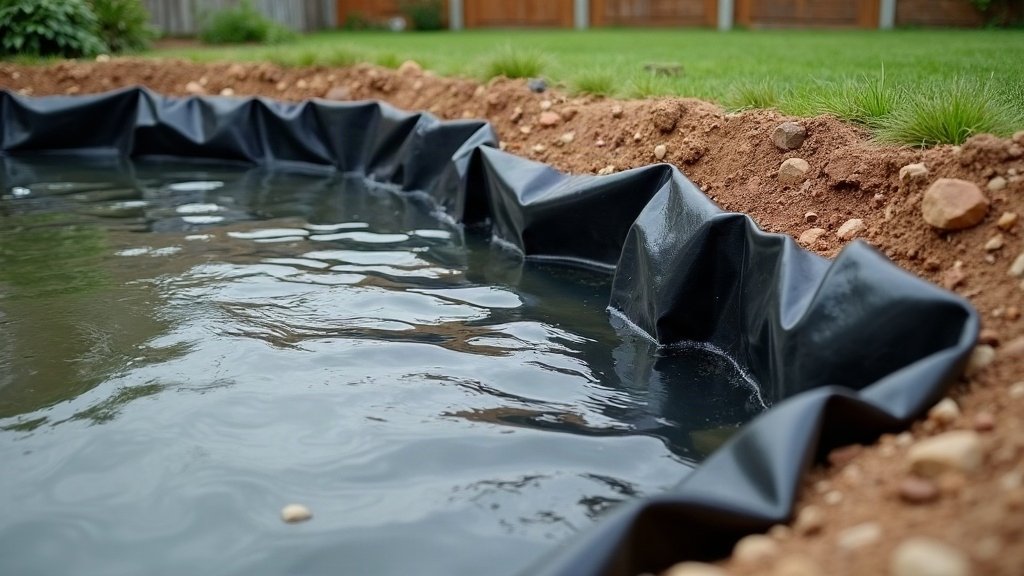
Almost no pond liner fails because the wrong material was chosen. It fails because something sharp worked its way up underneath, the sun got onto an exposed edge, or the perimeter was never properly held down. Get those three right and any of the common options will hold water for years. Get them wrong and the dearest liner on the shelf is weeping by the second summer.
So the choice is not which material lasts longest. It is how much freedom you want over the shape, how permanent the pond needs to be, and how much digging you are doing yourself.
Flexible liner: the one that suits most backyards
A flexible liner is a sheet you cut and drape into whatever hole you dig. EPDM is the synthetic rubber most people mean by pond liner. It stretches, so it settles into an irregular shape with fewer pleats than anything stiffer, and it stays flexible in the cold instead of going brittle. PVC and the polyethylene sheets cost less and will hold water, but they are harder work in a curved hole and give up sooner once ultraviolet light reaches them.
Sizing is arithmetic, not guesswork. Longest dimension, plus twice the deepest depth, plus an overlap each side to tuck under the edging. Same again for the width. Order the next size up, because a liner you can trim is a liner and a liner that is short is landfill.
One caution if fish are going in: buy sheet sold as pond grade or fish safe. Roofing grade rubber can carry additives that are fine on a roof and not fine in a closed body of water with fish in it.
Preformed: fast, rigid, and the shape is the ceiling
A preformed pond is a moulded shell you drop into a hole. The appeal is honest: water in the ground in a weekend, planting shelves built in, no folding and no stone to worry about under a sheet.
The trade is that the shell decides everything. You cannot make it bigger or deeper, and the hole has to match its underside rather than the other way round. Most preformed ponds that end up cracked or crooked were backfilled badly, leaving voids under the shelves so the shell carried weight it never should have. Work the fill in layers of sand, running water in as you go so it is supported inside and out at the same height, and check level both ways before the last goes in. Out by a couple of centimetres shows at the waterline forever.
Concrete: the permanent option, and what it asks of you
Concrete is what you build when the pond is part of the landscape rather than a feature sitting in it. Rendered blockwork or a reinforced poured shell gives you crisp formal edges, walls you can sit on, and a structure that takes foot traffic.
Two things get underestimated. Chemistry first: fresh concrete and render leach lime, which pushes pond pH up hard, so the structure must be fully cured then sealed with a pond safe coating before anything lives in it. Ground movement second. Much of Australia sits on reactive clay that swells and shrinks with the seasons, and a rigid box in moving ground cracks. That means proper reinforcement, and on a raised build an engineer rather than a hopeful guess.
If it does crack later, draping a flexible liner into the existing shell is a common repair, and you keep the edges you paid for.
The bits that actually decide whether it leaks
- Underlay: geotextile or old carpet under any flexible liner, because the stone you missed is the one that finds the sheet.
- Root check: cut out any root heading through the excavation, because a liner will not stop one that decides to grow.
- Edge detail: the liner must finish above the final water level the whole way round, held under coping, rock or turf, or the pond quietly siphons itself down to the low point.
- Ultraviolet cover: liner left in daylight is the part that perishes first, so cover the lot.
- Fill as you fold: run water in while you work the creases and let its weight pull the sheet into shape rather than fighting it by hand.
- Overflow: give the pond a deliberate low point for storm water to leave by, or it will choose its own.
Which one for your pond
- Informal shape, anything bigger than a bathtub: flexible liner, EPDM if the budget allows. Shells are dear per litre past a few hundred litres.
- First pond, small, want water this weekend: preformed shell, dug and backfilled carefully.
- Formal, raised, walk on the edge, built to outlive you: concrete, cured and sealed properly.
- Rocky or root heavy ground: flexible over generous underlay, or concrete with real reinforcement.
- A pondless waterfall reservoir: flexible liner, because the shape is never regular.
None of it changes how the water moves. Pump sizing follows volume and head height, and clear water comes down to filtration, shade and algae control, not the lining.
Where the rules come in
Four limits before you dig. Any fixed electrical connection for a pump or pond lighting, including an outdoor socket or hard wiring, is work for a licensed electrician. An automatic top up teed into the mains or potable supply needs backflow prevention and is work for a licensed plumber. Whether your pond needs a barrier or fence is set by your local council, and it varies with depth and by state, so ask before the hole exists. Filling under water restrictions, or topping up from a bore, is your state water authority’s call.
Start from the shape, not the shelf
Decide the outline, the depth and the edge treatment first and the liner picks itself. Then spend the effort on underlay and edging, which is where leaks actually come from. Still at the drawing stage? Our step by step garden pond build covers excavation and levelling before any liner goes near the ground.