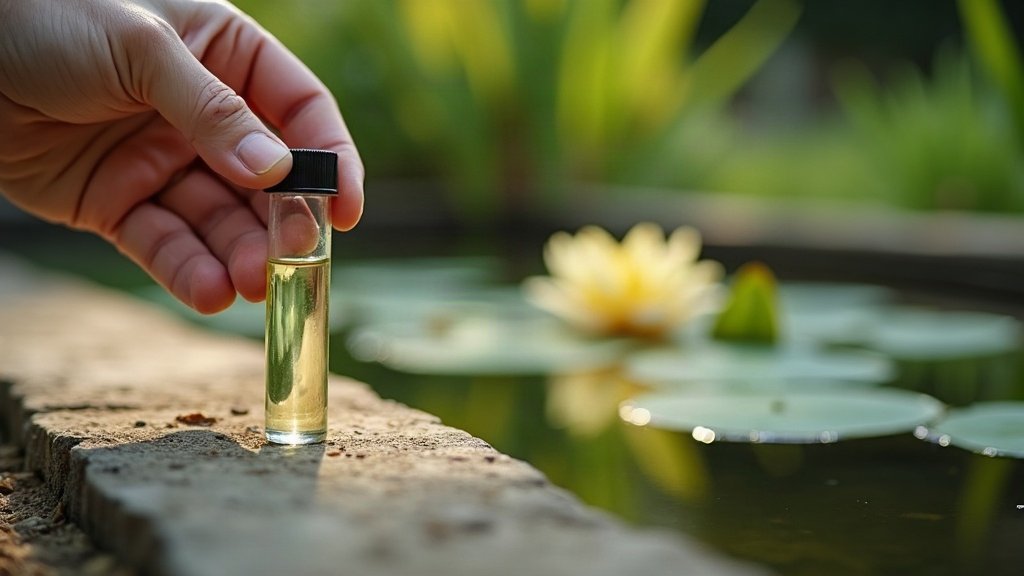
Your fish are hanging at the surface, gulping. The water looks fine, maybe a bit green. What’s actually wrong? A ten-minute water test at the pond’s edge is the place to start. The three numbers that matter most are ammonia, nitrite and pH.
You don’t need a chemistry background. You need to know what each number is telling you, how to take a sample that isn’t misleading, and what to do when a reading comes back wrong.
Why test water that looks clear?
Because the stuff that hurts fish is invisible. Fish waste, uneaten food and rotting leaves all break down into ammonia. In a healthy pond, bacteria living in your filter and on every surface turn that ammonia into nitrite, then turn nitrite into nitrate. Ammonia and nitrite are both toxic to fish. Nitrate is far less harmful and gets taken up by plants.
When that chain breaks, ammonia or nitrite builds up while the water still looks perfectly clear. Clarity tells you about particles and algae, not chemistry.
Strips or liquid kit?
- Test strips: quick and easy, dip and compare colours. Good for a fast weekly check, but they’re less precise and they go off quickly once the tub is opened and damp gets in.
- Liquid reagent kits: drops into a vial of pond water, wait, compare against a card. Slower, but more accurate.
Whichever you use, check the expiry date. Old reagents give confidently wrong answers, which is worse than no answer at all.
How to take a test properly, step by step
- Pick a consistent time: pH moves through the day, so test at roughly the same time each time you check. Early morning gives you the low point.
- Sample from the right spot: dip the vial about elbow-deep, away from the pump outlet, the waterfall and any spot where you’ve just topped up with the hose.
- Rinse first: swill the vial with pond water and tip it out before filling.
- Follow the kit exactly: the number of drops, the shaking and the waiting time all matter.
- Read in daylight: hold the vial against the white part of the card in natural light, not under a yellow patio globe.
- Write it down: date, time, reading, and anything you changed recently.
What the numbers mean
Ammonia
The target is zero, or as close to it as your kit can show. Any detectable ammonia means waste is being produced faster than your bacteria can process it. The usual causes: too many fish, too much food, or a filter that’s undersized or over-cleaned. Ammonia is also more toxic in warm water and at higher pH, so a reading that’s tolerable in winter can be dangerous on a hot summer afternoon.
Nitrite
Also zero. Nitrite shows up when the first lot of bacteria is working but the second lot hasn’t caught up. You’ll see it most in new ponds that are still establishing and after a filter has been over-cleaned. Fish with nitrite poisoning often look sluggish and gasp even when the water is well oxygenated.
pH
Most pond fish and plants are comfortable somewhere around 7 to 8.5. The exact figure matters less than stability. A pond that sits at 7.8 every morning is in better shape than one that swings from 7 to 9 between dawn and late afternoon. Those daily swings happen because plants and algae use up carbon dioxide during the day, pushing pH up, then release it overnight.
If your kit also measures KH (carbonate hardness), test that too. KH is the water’s buffer. When it runs low, pH can crash suddenly, often after heavy rain. New concrete or mortar does the opposite, leaching lime and pushing pH high until it’s sealed or cured.
A reading’s off. Now what?
- Ammonia or nitrite above zero: stop feeding for a few days. Do a partial water change, a common rule of thumb is around 10 to 20 per cent, and retest the next day.
- Treat your top-up water: many mains supplies are disinfected with chlorine or chloramine. Check with your local water utility, and use a dechlorinator rated for both.
- Look at the filter: if you rinsed the media under the tap, you’ve likely killed off the bacteria. Rinse it in a bucket of pond water instead. Our guide to pond filtration and UV clarifiers covers sizing and cleaning in more detail.
- Get oxygen in: stressed fish need it most, and warm water holds less of it. An air stone or a bit more surface movement buys time while you fix the cause. See whether your pond needs an aerator.
- pH swinging or low: check KH first. Raising KH steadily with a pond buffer is safer than dosing pH up or down directly, which tends to overshoot.
Don’t fix everything at once. Big, sudden changes stress fish more than a slightly off reading does. Make one change, wait, retest.
How often should you test?
For a new pond, test weekly for the first couple of months while the bacteria establish, and any time fish behave oddly. Once a pond has been stable for a season, monthly is usually enough, plus a check after heavy rain, a hot spell, adding new fish or cleaning the filter.
Stocking levels and feeding have the biggest influence on what your tests show. If you’re keeping goldfish or koi, our fish pond basics explains how much load a pond can handle. Plenty of healthy planting helps too, by soaking up nitrate before algae can use it. The aquatic plants guide is a good place to start.
Keep the kit dry and shaded, with the notebook beside it, and you’ll often spot trouble before your fish do.