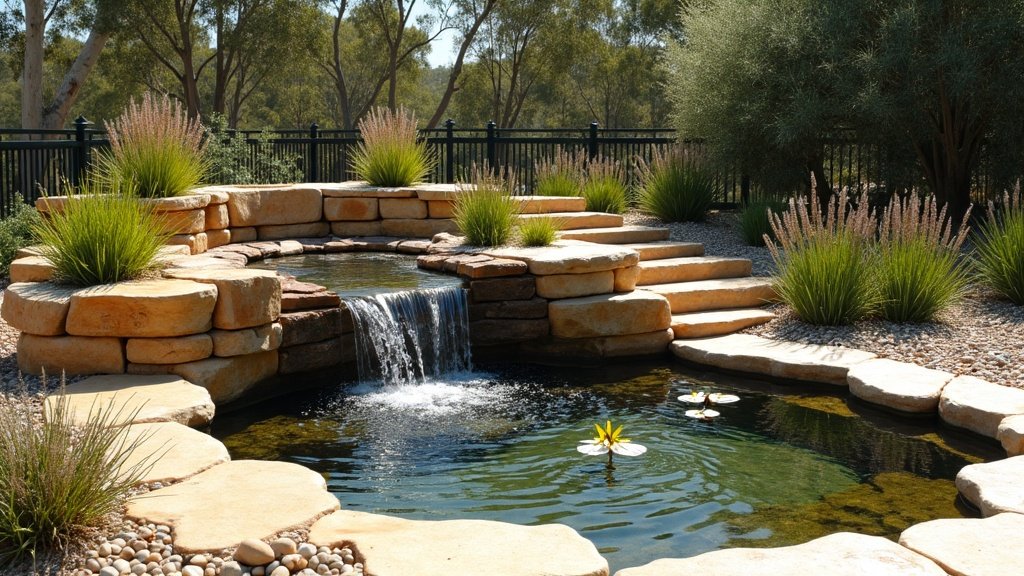
Two numbers decide which pond pump you buy: how much water the pond holds, and how hard the pump has to work to move it. Get the volume and the head height right and you land on a sensible pump the first time, instead of buying twice.
Start with the volume, not the pond
Measure length, width and average depth in metres, multiply the three together, then multiply by 1000. That gives you litres. A pond three metres long, two metres wide and half a metre deep on average holds about 3000 litres.
Average depth is the bit people fudge. Most backyard ponds have a shallow planting shelf around the edge and a deeper section in the middle, so the average sits well under the deepest point. Use the deep measurement and you will overstate the volume, sometimes badly.
If the pond is an odd shape, break it into rough rectangles and add them up, or read your water meter before and after filling. Filling a new pond is the one time you get an exact figure for free, so write it down somewhere you will find it again.
The turnover rule of thumb
The working rule most pond people use is to circulate the whole volume once an hour. So a 3000 litre pond wants a pump moving roughly 3000 litres per hour. That figure keeps water passing through the filter often enough to stay clear and keeps oxygen moving.
Adjust it for what is living in there:
- Lightly planted ornamental pond, no fish: turning the volume over every two hours is usually plenty.
- Standard mixed pond with a few goldfish: once an hour is the safe default.
- Koi pond: koi are heavy waste producers, so aim for a full turnover every hour as an absolute minimum and size the filter to match.
Turnover is really about the filter doing its job, and our guide to pond filtration and UV clarifiers covers how the two decisions fit together.
Head height is where most people come unstuck
Pumps are advertised at maximum flow, which is what they deliver pushing against nothing at all. Ask one to lift water and shove it through pipe and the flow drops away. Ignore that and a pump rated at 6000 litres per hour turns into a dribble at the top of your waterfall.
Total head is two things added together. Static head is the vertical distance from the pond surface up to the point where the water pours out. Friction loss is everything the water fights on the way: metres of pipe, every bend, the filter, the UV unit, any fittings that pinch the flow down.
You cannot calculate friction loss precisely in a backyard without a chart, so add a sensible allowance. On a short run of correctly sized pipe with a couple of gentle bends, half a metre to a metre on top of the vertical rise gets you close enough. Then read the pump’s performance curve, which every decent manufacturer publishes, at that total head figure. That number is the one that matters.
A waterfall changes the sum entirely
Once a waterfall or spillway is involved, flow gets judged by the eye, not the filter. A wide spillway with not enough behind it looks like a leaking gutter.
The starting point widely used in the trade is around 1500 litres per hour for every 10 centimetres of spillway width, which gives a modest sheet. Want a thicker curtain that reads as a proper waterfall? Roughly double it. A 40 centimetre spillway on that basis wants somewhere near 6000 litres per hour.
Now compare that against your turnover figure and take whichever is larger. The 3000 litre pond above wanted 3000 litres per hour for filtration, so the waterfall governs. If that number costs more to run than you are willing to wear, narrow the spillway rather than starving it.
Plumbing choices that quietly cost you flow
- Pipe diameter: go one size up from the pump outlet rather than down, because narrowing the pipe costs you more flow than any other single decision.
- Sweep bends over sharp elbows: each tight elbow behaves like several extra metres of pipe.
- Short runs: every metre of hose between the pump and the waterfall is friction you paid for and never see.
- A valve on the outlet: fitting one lets you trim a slightly generous pump back to the look you want, which is far easier than living with one that is undersized.
Whether the pump sits in the water or beside it is a separate decision with its own tradeoffs, and we have walked through that in the guide on submersible versus surface pumps.
Putting it together
Take that 3000 litre pond with a 40 centimetre spillway sitting 1.2 metres above the water and six metres of pipe running to it. The flow target is 6000 litres per hour because the waterfall governs. Total head is 1.2 metres of lift plus an allowance for pipe, bends and filter, so call it two metres. You are shopping for a pump that still delivers about 6000 litres per hour at two metres of head, which is a noticeably bigger unit than one whose box says 6000.
Where the do it yourself part stops
Plugging a pump into an existing weatherproof outdoor outlet is a homeowner job. Installing that outlet, running a new circuit or hard wiring anything is licensed electrical work everywhere in Australia, so it goes to a licensed electrician. Your state or territory electrical safety regulator is the authority on what needs a licence and what protection the circuit requires.
Sizing is far easier when the pond gets designed around the pump, which is why pump position comes up early in the step by step guide to building a garden pond. And if the pond will sit near where small children play, ask your local council about barrier requirements before you dig, because the rules vary by state and by depth.