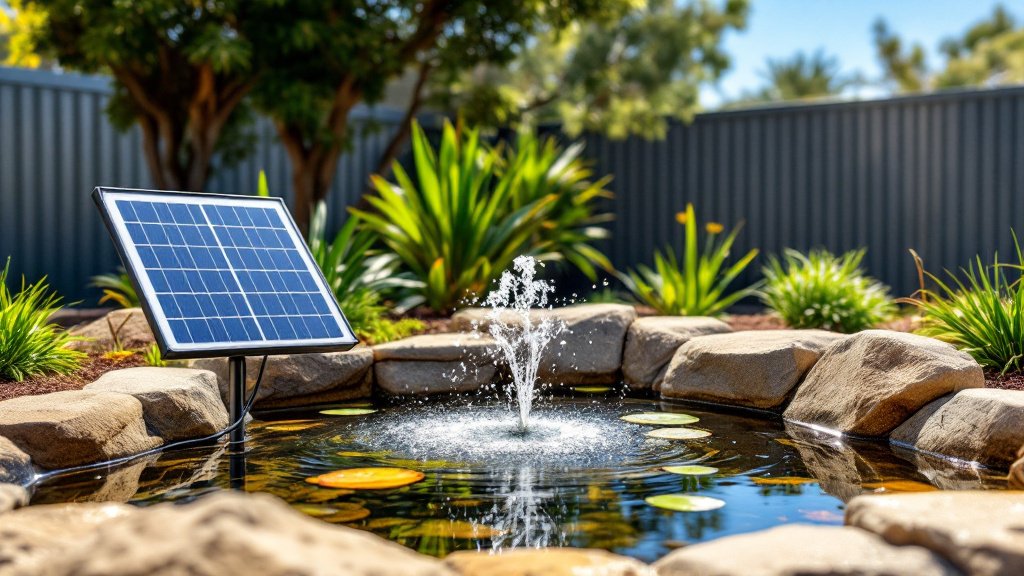
A solar pump will happily run a small fountain, a birdbath bubbler or a garden spitter on a sunny day, and it will do it without a cord, a trench or a power bill. What it will not do is reliably keep a filtered fish pond turning over around the clock, unless you add a battery and accept that you are building a small off-grid power system rather than buying a pump. That is the honest line, and most of the disappointment people have with solar pumps comes from buying on one side of it and expecting the other.
Direct drive versus battery buffered
Every solar pump kit on the shelf is one of two things, and the difference matters far more than the badge on the box.
- Direct drive: the panel wires straight to the pump, so the pump runs when the sun is on the panel and stops when it is not. A cloud goes over and the fountain drops off. The sun swings behind the house at four in the afternoon and it stops for the day.
- Battery buffered: the panel charges a small battery through a controller, and the pump draws from the battery. You get run time through passing cloud, into the evening, and on a grey day, though the battery only gives you what the panel managed to put in.
Direct drive kits are cheaper and simpler, and fine for pure decoration. If you want the water moving at a predictable time, or at all overnight, you want the battery.
Where solar genuinely earns its keep
The best case for solar is a feature sitting somewhere awkward: a pond down the back of a long block, a bubbler in a front garden with no outdoor outlet nearby, a small cascade on a rural property where the nearest power is a long way off. Running mains out to those spots means trenching, conduit and a sparky, and a solar kit sidesteps all of it.
It also suits anything ornamental where an intermittent run is fine. Nobody minds a birdbath fountain going quiet after sunset, and wildlife ponds are a good fit too, because surface movement through the day discourages mosquitoes and puts oxygen in the water while the still night is closer to what a natural pond does anyway.
Where it falls over
Filtration is the big one. A filtered pond, and especially one with fish, wants its whole volume moving through the filter continuously, because the bacteria doing the biological work need a constant supply of oxygenated water. Cut the flow for a long stretch and that colony starts dying back, so when the sun returns your filter is doing less than you think. If you are running fish, get the turnover right first and treat solar as an extra, not the main pump. Our guide to sizing a pond pump to flow and head walks through what the pump actually has to move.
Head height is the second trap. Solar pumps are generally modest performers, and lifting water up a waterfall or a tall feature eats the available flow quickly. A pump that looks impressive splashing away at ground level can arrive at the top of a metre of stacked rock as a dribble. Read the pump’s own performance curve at the height you are actually lifting to, and ignore the headline flow figure on the packaging, because that number is measured at zero lift.
Season is the third. Winter sun sits lower and the days are shorter, so a panel that carried the feature comfortably in January can leave it stuttering in June. If the feature matters to you year round, size for your worst month, not your best.
Panel siting is half the job
People agonise over the pump and then drop the panel wherever it happens to fit, which is backwards. A good pump on a badly placed panel performs worse than a modest pump on a well placed one.
In Australia the panel wants to face north, tilted up rather than lying flat, and it wants to be clear of shade for the middle of the day. Watch the spot across a full day before you mount anything, because the shade line from a fence, a pergola or a neighbour’s gum moves a long way between morning and afternoon. Give yourself enough cable to move the panel later, and wipe the dust off every few weeks. A dusty panel quietly loses you output and you will blame the pump.
The electrical side, briefly
A self contained low voltage kit, panel to controller to pump, is something you can install yourself. The moment you want a mains powered pump in the garden instead, or an outdoor outlet to plug one into, that is licensed electrical work in Australia and it belongs to a licensed electrician. Requirements and licensing are set by the electrical safety regulator in your state or territory, so check with them rather than taking a shop assistant’s word for it. Water, soil and mains voltage is not the place to save a few dollars.
Keeping it running
Solar pumps are usually small submersibles with tight clearances, which means they clog faster than a full sized pond pump and they do not enjoy running dry. Rinse the intake screen regularly, keep the water level up in summer when evaporation is quick, and clean the impeller if the flow drops off before you assume the panel is at fault. In cooler months, the same care that applies to any pond pump over winter applies here as well.
Buy solar for what it is good at, moving water where power is inconvenient and the feature can afford to go quiet, and it will do that job for years. Ask it to be life support for a stocked pond and it will let you down on the first cloudy week. If you are still working out what your setup needs, start with our guide to water in the Australian garden.