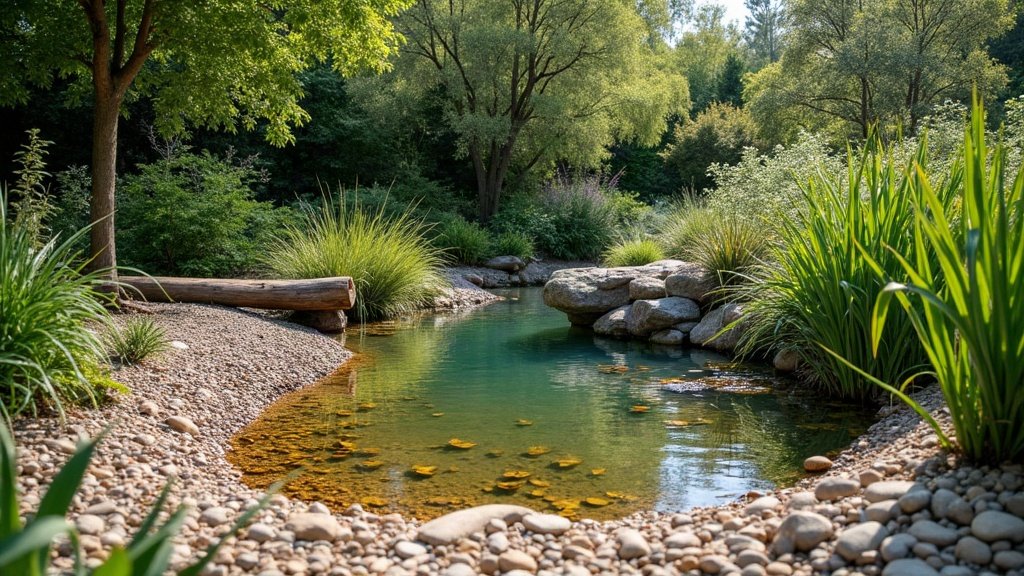
A frog-friendly pond is shallow at the edges, thick with native plants, free of fish and left mostly alone. Get those four things right and local frogs will usually find it on their own. You don’t stock a frog pond. You build the conditions and wait.
That waiting is the hard part for most people. Frogs might turn up in the first warm, wet spell, or it might take a season or two. Either way, don’t go and fetch them from somewhere else. More on why below.
What makes a pond suit frogs rather than fish?
Frogs need to get in and out of the water easily, lay eggs where nothing eats them, and shelter close by. A typical ornamental pond fails on all three. It has steep sides, goldfish that hoover up eggs and tadpoles, and a bare paved edge with nowhere to hide.
- Shallow, sloping edges: at least one side should run out like a beach, so frogs and tadpoles can move from deep water to damp ground.
- One deeper spot: deep enough that the pond won’t dry out or cook in a hot week, which gives tadpoles somewhere to retreat.
- No fish: goldfish, koi and most native fish will eat eggs and tadpoles. A frog pond and a fish pond are two different projects.
- Cover all round: rocks, logs, leaf litter and dense groundcovers near the water give adult frogs somewhere cool and damp to sit out the day.
If you’re starting from scratch, our step-by-step guide to building a garden pond covers digging and shelving. For a frog pond, just make the shelves wider and the slope gentler than you would for fish.
Where should it go in the yard?
Put it somewhere with a mix of sun and shade. Full sun all day heats a shallow pond fast and feeds algae. Deep shade under a big tree means cold water and a constant drop of leaves.
Keep it away from where you spray. Frogs take in water and chemicals through their skin, so a pond next to a sprayed lawn or a rose bed that gets regular treatments is a poor bet. Run your downpipes and paving runoff away from it too.
Quieter corners work better than the spot right outside the back door. Frogs will put up with people, but they won’t put up with a dog that wades in every afternoon.
Which liner and edge work best?
A flexible liner is usually the easiest way to get a long, gentle slope. Preformed shells tend to have steep walls and narrow ledges, which is the opposite of what frogs want. Our comparison of EPDM, preformed and concrete pond liners goes through the trade-offs in detail.
Once the liner is in, cover the shallow end with soil, gravel and flat stones so frogs have grip. Bare liner is slippery, and a tadpole that’s turning into a frog can’t climb a slick plastic wall.
What should you plant?
Plant in layers: submerged plants for oxygen and tadpole cover, rushes and sedges along the margins for egg laying and shade, and dense groundcovers on the bank. Plants also soak up nutrients that would otherwise feed algae.
Go local wherever you can. A native nursery near you will know which rushes, sedges and water plants grow naturally in your area. Be wary of cheap pond plants bought online, because some popular water plants are declared weeds in parts of Australia and can choke a waterway if they escape. Our guide to choosing aquatic plants for a balanced pond explains what each layer does.
Do you need a pump in a frog pond?
Not necessarily. Plenty of good frog ponds are still water with heavy planting. Frogs generally prefer calm water for laying, so a strong waterfall or a jet fountain works against you.
If you want some movement, keep it gentle and put a guard or sponge pre-filter over the intake. An unguarded intake will pull in tadpoles. A small, low-flow solar pump trickling over a stone is often plenty. Any mains-powered pump needs a properly installed outdoor power point, and new fixed wiring is a job for a licensed electrician.
What about mosquitoes, algae and top-ups?
A balanced pond with frogs, dragonfly larvae and other aquatic insects usually keeps mosquito numbers down. Don’t add mosquitofish (gambusia). It’s an introduced pest that preys on frog eggs and tadpoles.
Skip chemical algae treatments. Shade, planting and patience fix green water more safely. Top up with rainwater where you can. Tap water carries chlorine or chloramine, so if you must use it, add small amounts at a time.
Can you move frogs or tadpoles in yourself?
Don’t. Moving frogs, spawn or tadpoles between sites can spread disease, including the chytrid fungus that has hit frog populations hard. Taking native frogs or tadpoles from the wild is also regulated in most states. If you’re unsure what’s allowed, check with your state environment or wildlife agency before you touch anything.
In parts of Queensland, northern New South Wales and northern Australia, cane toads will use a garden pond too. Toad eggs come in long strings, while native frogs usually lay clumps or floating foam. Native frogs get mistaken for toads all the time, so confirm the identification using your state or local council’s guidance before removing anything.
Is a frog pond safe with kids around?
Shallow edges help, but any water is a drowning risk for a toddler. Rules on barriers around garden ponds vary by state and council, so check locally. Our backyard pond safety guide goes through fencing, depth and covers.
Build it, plant it, leave the fish out and resist the urge to tidy. The first time you hear a chorus from your own pond on a warm night, you’ll know it worked.