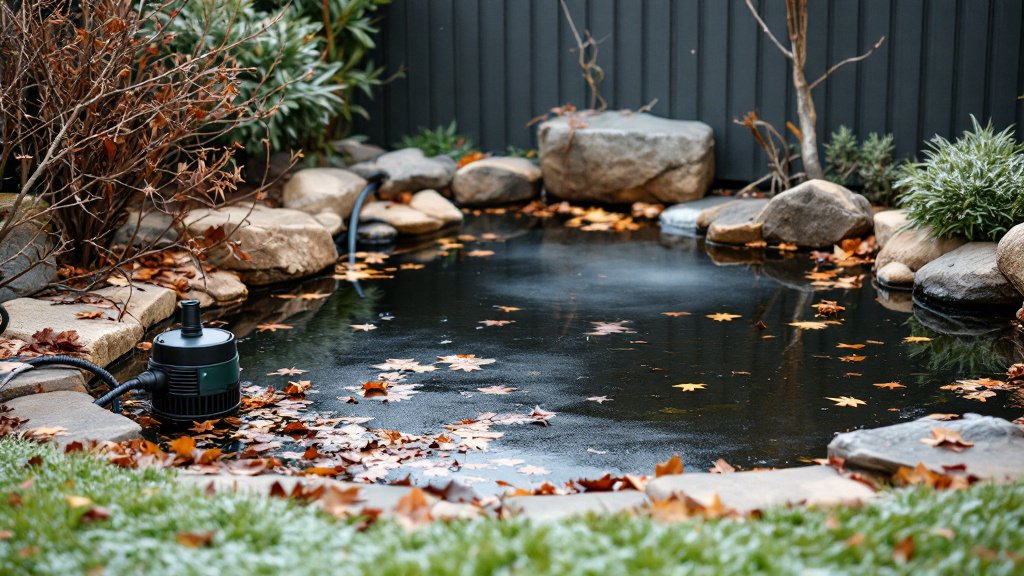
In most of Australia, winter pond care is refreshingly boring: leave the pump running, cut the feeding right back, and keep the leaves out. Shutting the whole system down for the cold season is a frost country job, and even there it is more about protecting the equipment than protecting the fish. A pond of any decent volume holds warmth far better than the air above it, so the fish near the bottom are having a gentler winter than your back verandah suggests.
Leave the pump running unless you have a real reason not to
The most common winter mistake is switching everything off in May and turning it back on in September. It feels sensible. It is not.
Your biological filter is a living colony of bacteria sitting on the filter media, and those bacteria convert fish waste into something harmless. They slow right down in cold water but they do not disappear. Cut the flow for a few weeks and they starve and die off. Fire it back up in spring and you have a filter full of nothing, a pond full of hungry fish and an ammonia spike heading your way. That is behind a lot of the fish losses people blame on spring. More on it in the guide to pond filtration and UV clarifiers.
Moving water also keeps oxygen going in and the gases from decomposition coming out. A still pond with a layer of rotting leaves on the bottom is a far worse place to be a fish than a cold one. If the running cost is what is bothering you, read the wattage off the pump’s rating plate rather than guessing.
Feed less, and feed differently
Cold water slows a fish’s metabolism right down. The rule of thumb most pond keepers work to is that once the water sits below roughly 10 degrees, a goldfish or koi is not properly digesting what it eats, and undigested food fouls the water on the way out.
- Switch to a wheat germ based food: it is formulated to break down more easily in cold water than a high protein summer pellet.
- Feed in the warmest part of the day: early afternoon, not first thing on a frosty morning.
- Feed only what disappears in a couple of minutes: anything still floating afterwards goes to the filter as waste.
- Stop altogether when they stop coming up: fish sitting on the bottom ignoring food are done for the season.
They will not starve. A healthy fish that went into winter with condition on it is built for exactly this. There is more on reading fish behaviour in our piece on keeping fish healthy in a backyard pond.
The frost country exception
On the Tablelands, around Canberra, in the Victorian high country or the Tasmanian highlands you have a genuine freezing problem, and it is the equipment at risk more than the pond.
Water expands as it freezes, so any water left sitting in a pump body or an exposed pipe can crack the housing, and you will not find out until you switch on in spring and stand in the puddle. If you pull a pump out for the season, drain it, dry it, and store it somewhere that does not freeze. Lag any pipework you cannot drain.
For the pond itself, depth is your friend, which is worth getting right when you build the pond. If ice does form, do not smash it: you would be hammering on the surface of a pond full of fish that are barely moving. Sit a pot of hot water on the ice to melt a hole, or keep a small area open with an air stone.
Turn spray features down or off in freezing weather. Throwing water into freezing air chills the pond fast, and splash on paving becomes an ice sheet the postie will find the hard way.
Leaves, plants and the things that quietly cause trouble
Leaf drop causes most of the cool season water quality grief. Leaves sink, rot and pull oxygen out of the water. A net over the pond for the worst of the drop is cheap. Skim whatever gets through before it sinks.
Cut back marginal and aquatic plants as they die off rather than letting them collapse into the water and rot there. Keep the water topped up too. A few other things worth checking while you are down there:
- Pump intake and pre-filter: cold weather debris blocks these just as fast as summer weed does, and a starved pump runs hot.
- The UV lamp: green water is far less common in the cold and UV lamps have a limited useful life, so turn the lamp off if you like, but leave the pump and filter going.
- Leads and connections: look for perished insulation, cracked plugs and anything sitting in a puddle.
- Any pump that has sat dry: turn the shaft over by hand before you power it up, because mechanical seals stick when they dry out.
Where the do it yourself part stops
Plugging a pond pump into an existing outdoor socket is a homeowner job. Fixed wiring, a new outdoor circuit or a hardwired isolator is licensed electrical work everywhere in Australia and has to be done by a licensed electrician. Check with your state regulator: Energy Safe Victoria, NSW Fair Trading, or the Electrical Safety Office in Queensland. Whatever you run outdoors should be protected by an RCD.
Coming out the other side
Spring is where good winter work gets undone. Resist the full clean out on the first warm weekend, because scrubbing filter media under the tap kills the bacteria colony you just spent three months protecting. If the media genuinely needs it, rinse it in pond water and leave the rest alone.
Bring the feeding back gradually as the water warms, starting with the wheat germ food. Give any stored pump a look over first: seals, impeller, and whether it draws water within a minute.