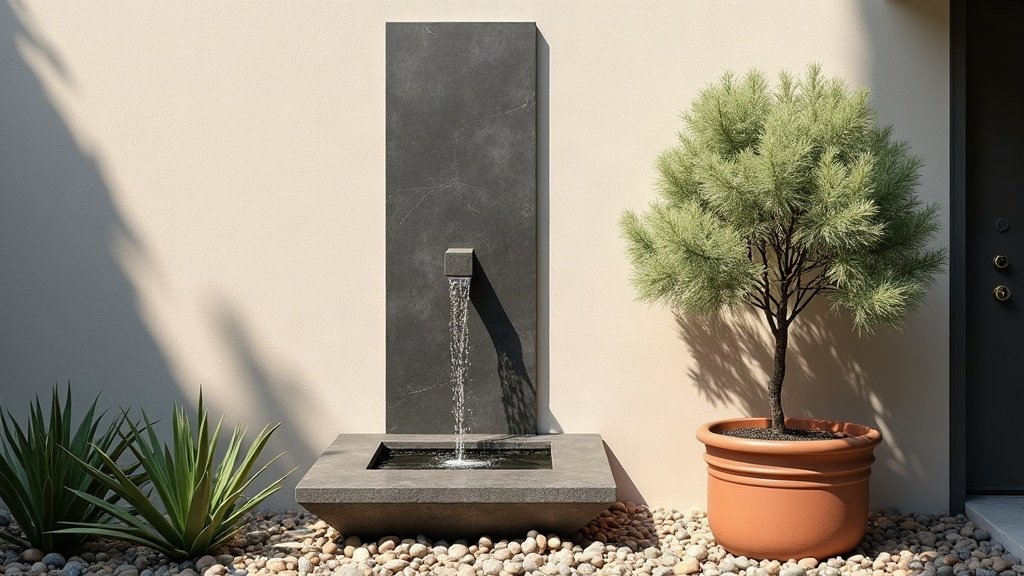
Got a blank wall in a courtyard, or a balcony with no room for anything on the floor? A wall-mounted water feature is one of the few ways to get moving water into that kind of space. Getting one right has less to do with the feature than with the wall behind it, where the water ends up, and how you’ll get to the pump when it needs a clean.
Three kinds of wall feature, and what each asks of your wall
These get lumped together, but they behave very differently on a wall.
- Freestanding wall-style features: a panel on its own base, with water running down the face into a reservoir below. It stands against the wall, so the wall carries nothing. The easy option for renters and no-drill balconies.
- Wall-hung features: a panel, mask or bowl hung on the wall, usually with a small reservoir in the bottom lip. Almost no floor space, but the whole thing, water included, hangs off your fixings.
- A spout into a trough or basin: a spout fixed to the wall, pouring into a trough or bowl below. The pump sits in the lower vessel and a hose runs up to the spout. It looks built in, and takes the most planning.
Our guide to choosing and placing garden water features covers the basics. This post sticks to what’s specific to walls.
Can your wall take it?
Water is heavy, and a wall-hung feature holds its weight a long way off the ground. Before you hang anything, find out what the wall is made of and how the feature’s maker says to fix it.
- Solid brick, block or concrete: the friendliest backing. Use masonry anchors rated for the load, drilled into the brick or block itself rather than the mortar joints.
- Timber or steel stud walls: the fixings need to go into the studs or into proper noggins, not just the cladding. Hanging a full reservoir off plasterboard or thin sheeting is how features end up on the ground.
- Rendered walls: render is a skin, not a structure. Find out what’s underneath and fix through into that.
If the maker doesn’t state the filled weight, ask. If you can’t tell what’s behind the wall, go freestanding.
Moisture behind the feature
A feature that splashes or wicks water onto the wall will leave its mark. Porous render and bare brick can stain, grow moss or show white mineral deposits, and a timber-framed wall can suffer if water gets past the cladding. Pick a design with a solid backing panel, and check the wall after the first few weeks.
Balconies: approval, splash and wind
On an apartment balcony, the first question isn’t which feature. It’s what you’re allowed to do. Drilling into external walls, adding weight to the slab or running new power can touch common property, depending on your strata plan. Check with your owners corporation, body corporate or strata committee before you start; the rules vary by state and territory. Renters also need the landlord’s okay for anything fixed to a wall.
Then there’s wind. A breeze that feels mild at ground level can be much stronger a few floors up, and it carries spray sideways off a sheeting face or tall spout, onto your floor and possibly the balcony below. A short drop with a gentle flow, set back from the balustrade, is far easier to live with.
A small reservoir runs dry faster than you’d think
Wall features usually hold less water than a bowl or urn of similar looks, because the reservoir has to be slim. Sun, wind and splash all draw it down, and a pump that runs dry can overheat and fail. Expect to top it up more often than a ground-level feature, especially in summer. A model with a visible water level helps.
Keep the pump small, too. A feature built for a gentle trickle doesn’t need much flow, and oversizing it just throws more water off the face. For a replacement pump or a spout-and-trough design, the thinking in our guide to sizing a pond pump for flow and height applies at a smaller scale: match the flow to the height the water has to climb.
Getting power to it
A mains-powered feature needs an outdoor power point close by. If there isn’t one, installing it is a job for a licensed electrician, with the rules set by your state or territory’s electrical safety regulator. Don’t run an extension lead through a window or door to a feature sitting in water. On a balcony, a new outlet may also need the same strata sign-off as any other change.
Where there’s no power at all, a solar feature can work if the wall gets direct sun for a good part of the day. A shaded courtyard wall is usually a poor spot for one. Our comparison of solar and mains-powered fountains helps you pick.
Plan how you’ll reach the pump
Every pump needs its intake cleared now and then. On wall-hung models, check the pump lifts out without taking the feature off the wall. On a spout-and-trough setup, keep the pump and hose where you can reach them, not sealed behind render. If cleaning means unscrewing a heavy panel full of water, it won’t get done.
A word about noise
Between courtyard walls or stacked balconies, water noise carries. The trickle you love from your chair can be what your neighbour hears through a bedroom window at night. A timer, or a flow you can turn down, keeps the peace.
Before you buy
- Know your wall: what it’s made of, and whether you’re allowed to drill it.
- Ask for the filled weight: and fix to suit, or go freestanding.
- Keep the flow gentle: especially on a windy balcony.
- Sort power first: an existing outdoor outlet, a licensed electrician, or a sunny wall for solar.
- Make the pump easy to reach: so you’ll actually clean it.