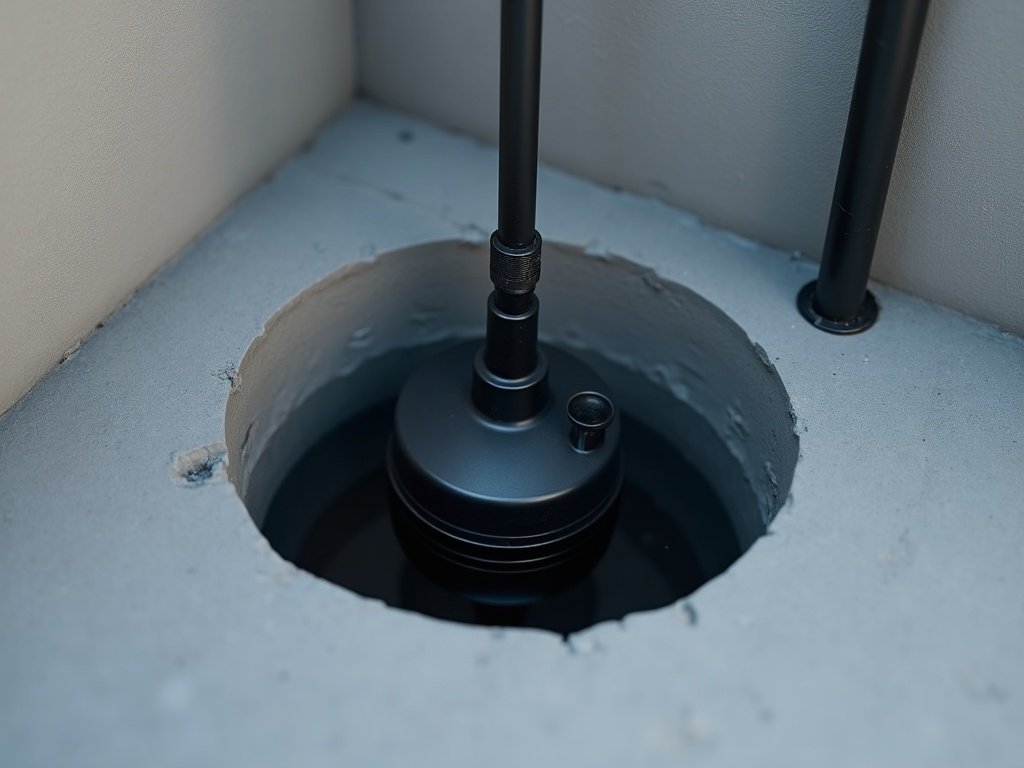
Every time a decent storm rolls through, the water pools against the back slab and starts creeping toward the door. You bail it, you sweep it out, and the next downpour it is right back. That is the exact job a sump or stormwater pump is built for: shifting water that has nowhere else to go, before it gets inside. Here is how they work, how to tell a pump problem from a plain drainage problem, and who should be doing the connecting.
What a sump or stormwater pump actually does
A sump pump sits in a pit at the lowest point of a space that keeps flooding: a garage, a laundry, a shed floor or a boggy yard corner. Water drains into that pit, the pump senses it, and it lifts the water up and out to somewhere it can drain away safely. A stormwater pump does the same job on a bigger scale, clearing the runoff a heavy storm dumps faster than your normal drains can carry it off. Both are usually submersible units that sit down in the water rather than perched above it, and our submersible vs surface pumps guide covers that style versus a surface pump. Worth saying too: not every drop has to be pumped to waste, the clean roof runoff is often worth catching in a tank, which our rainwater harvesting guide covers, but a sump is about the water that has already pooled where you do not want it.
The pit, the float switch and how it runs itself
The clever part of a sump setup is that it looks after itself. You are not meant to stand there flicking it on. Three bits do the work.
- The pit: a lined hole at the low point that gathers the water and gives the pump a reservoir to draw from, so it is not chasing a thin film across the floor.
- The float switch: a floating trigger that rises with the water and kicks the pump on at a set level, then drops and shuts it off once the pit is drained, so it only runs when there is actually water to move.
- The discharge line: the pipe that carries the water up and away to a legal discharge point, kept clear and running downhill so nothing flows back into the pit.
Get those three right and the system quietly does its thing through a wet week without you thinking about it.
Pump problem or drainage problem? Work out which first
Before you spend a cent on a pump, be honest about why the water is turning up. A pump treats the symptom, but sometimes the water should never have pooled there at all. Have a look at the lie of the land after rain. If the ground slopes back toward the house, or a paved area sheds to one low spot, the real fix might be regrading, a spoon drain or a strip drain to carry water away before it ever collects. A pump earns its place where water genuinely has nowhere else to go, a below-grade garage or a natural low point, not as a patch over drainage that could be sorted properly. Money spent getting the fall right often saves you running a pump for the life of the house.
When a blocked stormwater line is the real culprit
Here is the one that catches people out. The pit keeps filling, the pump keeps straining, and everyone blames the pump, when the actual trouble is downstream. A stormwater line choked with tree roots, silt or a collapsed section cannot take the water away, so it backs up and floods the very spot you are trying to keep dry. If a pump that always coped suddenly cannot keep up, or water is surfacing at pits and gullies it never used to, suspect the line before you condemn the pump. Clearing or repairing that pipe often fixes the flooding outright. One important note: where stormwater is legally allowed to discharge, whether to the street, a legal point of discharge or the kerb, varies by council, so check your local requirements rather than just running a pipe to wherever is handy.
Backup for the storm that really matters
The cruel irony of a stormwater pump is that the storm big enough to need it is often the one that knocks the power out. A mains pump with no electricity is just a lump of plastic in a full pit. If flooding into the house is a genuine risk, it is worth a backup: a battery-backed pump that carries on when the power drops, or a second pump plumbed in so one can take over if the other fails. On a property that floods badly it is cheap insurance against the worst night of the year.
Who installs and connects what
This is where you draw a firm line. Dropping a portable pump into a pit and running a hose for a one-off is one thing. A permanent sump or stormwater system is another, and parts of it are not DIY.
- The electrical side: connecting a pump to power, or putting a proper outdoor point where one is needed, is work for a licensed electrician on an RCD-protected circuit, not something to wire up yourself around water.
- The pit and discharge: cutting a sump into a habitable or below-ground floor, and where the water is legally allowed to go, is not straightforward, and discharge points can be regulated by your council, so it pays to get it designed and signed off properly.
Sort out why the water is really there, get the pump matched to the job and the drainage done right, and leave the wiring and the fixed discharge to the licensed trades. Do that and the next big storm becomes a non-event instead of a night bailing. For how this sits alongside the rest of your outdoor water setup, our guide to water in the Australian garden ties it all together.