It turns up at night. The pump out by the tank kicks in the way it has for two years, except this time there is a rattle under the hum, or a thin whine hanging in the air after the water stops. Nothing has failed. The tap still runs. But a pump that changes its sound is telling you something well before it stops working.
Almost every new pump noise traces back to one of five things: air where there should be water, something loose, something worn, water shut off too fast, or vibration finding a hard surface to travel along. Work out which one you are hearing and the fix usually follows.
Start by working out what actually changed
Before you pull anything apart, work out whether the noise is genuinely new. Plenty of pumps have always been loud and the owner only notices once a fence goes up and bounces the sound back. That is not a fault. It is acoustics, and the fix is siting, not servicing.
A real fault almost always comes with a change you can point to. Did it start after something was done to the system, like a new filter or a valve someone closed and forgot? Does it track what the pump is doing, turning up on startup or only under load? And is anything else off, such as weaker flow or a motor running hotter than it used to?
What the noise itself is telling you
A flat electrical hum, but the pump is not moving water
If the motor hums and nothing turns, it is getting power but cannot start spinning. On a single phase pump that usually points at a failed start capacitor, or an impeller seized by grit, rust or jammed debris. Do not leave it humming while you think. A stalled motor heats up fast and cooks its own windings.
Rattling and clattering
Rattle is the friendly one. It is nearly always something loose or somewhere it should not be: a strainer lid that is not seated, leaves and pebbles knocking around in the basket, mounting bolts that have worked loose, a loose fan cover, or unclipped pipework tapping a wall. On pond pumps, gravel drawn into the impeller chamber makes exactly this sound.
A gravelly rumble, like the pump is chewing marbles
That rumbling growl is cavitation, and it means the pump is starving for water on the suction side. Vapour bubbles form there and collapse violently once they hit pressure inside the pump. It sounds harmless. It is not. Cavitation pits impellers and wrecks seals over time. Look for a blocked strainer or foot valve, a partly closed suction valve, a clogged pre filter, a suction line too long or too narrow for the job, or a pond pump sitting so shallow it snatches air.
Knocking or banging in the pipes
A single heavy thud as the pump shuts down is water hammer: moving water hitting a closed valve with nowhere to go. Repeated thumping every few seconds is a different problem. That is short cycling, and on a pressure system it usually means the pressure vessel has lost its air charge and can no longer cushion the switch.
A rising screech or a whine that keeps getting worse
Whine that climbs with the motor and gets louder month on month is mechanical wear, most often bearings or a seal that has run dry. This one does not plateau. A bearing that has started to complain is on a countdown, and running it to failure usually takes the shaft with it.
Vibration you feel more than hear
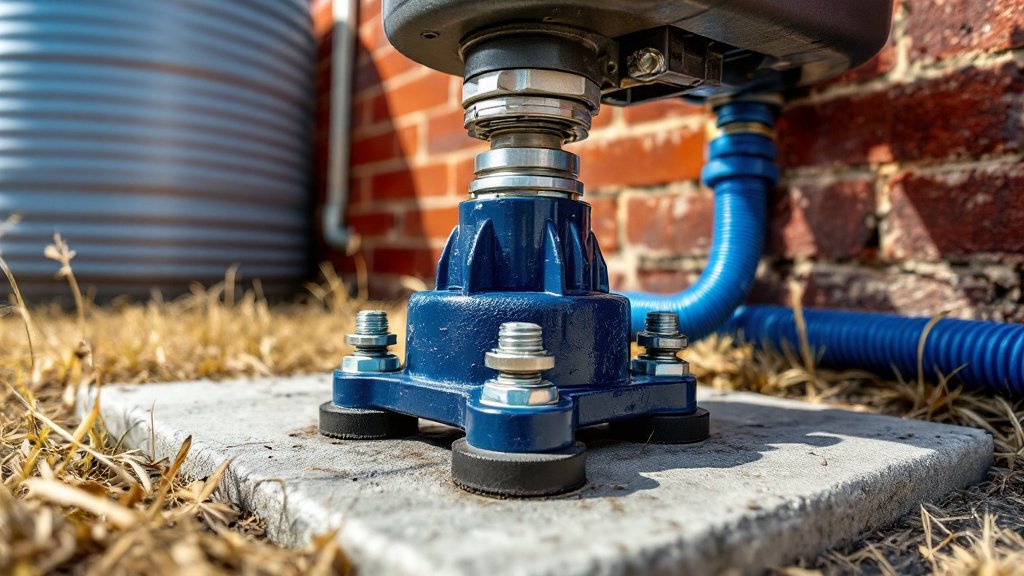
Sometimes the pump is fine and the mounting is the whole problem. A pump bolted hard onto a hollow deck, a thin steel frame or a plastic pit uses that surface as a soundboard. Rigid pipework does the same, carrying the buzz along a wall into a bedroom two rooms away. Three things usually settle it: a solid level base with rubber anti vibration pads underneath, a short flexible connector or braided hose to break the rigid pipe run, and keeping the unit off shared walls and hollow structures.
Vibration that comes on suddenly with no other symptom is different. Treat that as a warning: sudden imbalance means a damaged impeller, a bent shaft or a failing bearing, and it chews through seals quickly.
What you can safely sort out yourself
Isolate the power first, every time, at the switch or the outlet. Then work the simple stuff, before you go looking for an expensive fault.
- Clear the strainer basket and foot valve: leaves, grit and silt are the cheapest cause to rule out first.
- Check the suction side for air leaks: loose joints, tired thread tape and hairline cracks all let the pump draw air.
- Tighten mounting bolts and pipe clips: hand tight is not tight, and one loose clip will rattle a whole wall.
- Confirm submersion on pond and fountain pumps: a pump running half out of the water will whine and gulp.
- Open everything that should be open: a valve shut during maintenance is a classic cause of sudden cavitation.
Where to stop and call someone
There is a clean line here. Anything mechanical inside the wet end, meaning impellers, seals and bearings, is a job for a pump service agent unless you genuinely know the unit. Anything electrical on a hardwired pump is licensed work in every Australian state and territory, and needs a licensed electrician working to the AS/NZS wiring rules. That covers capacitors, wiring, switchgear and the motor housing. Your state electrical regulator sets those rules and can confirm a licence. Around ponds and pools the safety margin is thinner than usual, so it is not the place to have a go.
The habit worth building is listening to the pump while it is healthy, so you know its normal. Catching the change early is what keeps a cheap fix cheap.