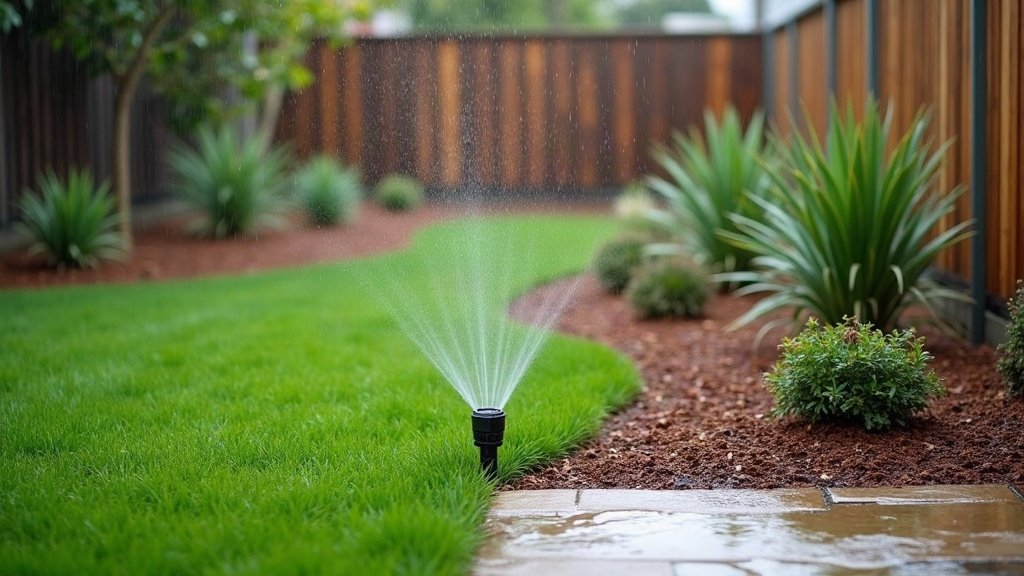
It’s pouring at six in the morning and the sprinklers come on anyway. The lawn gets a second soaking it didn’t need, and the tank you were saving for February drops for nothing. That’s the job a smart irrigation controller is built to stop.
Short answer: a smart controller changes how long and how often each zone runs based on the weather, and a plain timer can’t. If your system has more than a couple of zones, or you water from a tank, it usually earns its place. If you’ve got one dripper line on a balcony, it probably doesn’t.
What a smart controller does that a timer can’t
A standard timer runs each station for set minutes on set days, rain or shine, July the same as January. A smart controller starts from that schedule and adjusts it. The main tools it uses:
- Weather-based adjustment: it estimates how much water the garden lost to heat, wind and sun since the last cycle (often called evapotranspiration, or ET) and tops up roughly that much.
- Rain skip: it holds off when rain has fallen or is forecast, then resumes once the ground has had a chance to dry.
- Soil moisture sensors: a probe in the root zone tells the controller whether the bed is actually dry, instead of guessing.
- Flow sensing: a meter on the supply line spots a burst pipe or a snapped sprinkler head and shuts the zone down.
You won’t need all four. In a typical suburban yard, rain skip plus seasonal adjustment covers most of it.
Where the weather data comes from
Wi-Fi and online weather
Most units pull forecast and observed weather for your address over home Wi-Fi. They’re easy to set up and need no extra hardware. The catch is that the nearest data point might be a few suburbs away. On the coast, or anywhere with patchy rain, that can mean it skips when your yard is dry or waters when you’ve just had a downpour. Check the Wi-Fi actually reaches the wall where the controller lives, because a unit that keeps dropping offline falls back to its basic schedule.
On-site sensors
A rain sensor on the fence or gutter, or a soil moisture probe in the main bed, reads your actual yard. Pairing a Wi-Fi controller with a wired rain sensor gives you both: forecast data for planning, and a local reading that says “it’s wet here, stand down”.
Sensor-only controllers
Some controllers skip the internet and rely on local sensors alone. They suit rural blocks and holiday houses with poor Wi-Fi. You lose forecast skipping, but nothing stops when the router does.
Match the zone count to how the garden drinks
Controllers are sold by station count. Count the solenoid valves you have now, then add a couple for beds you’ll plant later.
Zones only help if each one waters plants with similar needs. No controller fixes a station running lawn sprays and native shrubs together. Fix that first with hydrozoning, grouping plants by water needs, then give each group its own station and its own settings.
Running a smart controller with a pump
If your irrigation runs off a tank or bore pump rather than mains pressure, look for a controller with a pump start or master valve output. It switches a relay so the pump runs only while a station is open.
- Relay, not direct wiring: the controller’s output is low voltage and can’t run a mains pump on its own. It drives a pump start relay, and any hardwired 240V work on that relay or the pump circuit is a job for a licensed electrician.
- Dry-run protection: a weather-smart controller doesn’t know the tank is empty. Your pump still needs its own low-level cut-out or protection. See choosing a pump for a water tank for how pressure and transfer setups handle that.
- Pressure to suit the zone: drip lines and pop-up sprays want very different pressures. Our guide to setting up drip irrigation from a pump covers regulators and zone layout.
On mains-fed systems, the irrigation connection to the house supply needs the right backflow prevention, and that’s licensed plumber work. Your water authority sets the requirements. In the Illawarra, CS Plumbing Services installs and tests backflow devices; elsewhere, ask your local plumber.
Water restrictions and watering days
Most smart controllers let you lock out days and time windows. Use it. Rules on when you can run sprinklers and drip vary between water authorities and change with storage levels, so check your local water authority’s current restrictions and set them into the controller.
Setting it up so the “smart” part works
Out of the box, most controllers guess. The adjustments are only as good as what you tell each zone:
- Soil type: sandy soil drains fast and needs shorter, more frequent cycles. Clay soaks up slowly and runs off if you rush it.
- Plant type: lawn, veggies, shrubs and established natives each get a different factor.
- Emitter type: sprays put water down far faster than drippers. Pick the wrong one and the run times will be miles out.
- Slope and sun: a sloped zone may need cycle and soak, with short bursts and a pause between them, to stop runoff. A shaded side bed needs less than a west-facing one.
Then watch it for the first fortnight. Dig a trowel into the bed the morning after a cycle: soggy means trim that zone back, bone dry means bump it up. The guide to watering beds, lawns and new trees explains what deep, infrequent watering should look like in the soil.
When it isn’t worth the money
A smart controller won’t fix a leaking fitting, a blocked dripper or a zone that mixes lawn and natives. On one or two stations, or a few pots, a decent standard timer does the job. It pays off on bigger gardens, tank-fed systems and properties left empty for weeks.