If your pump clicks on and off every few seconds instead of running a steady burst, it is short cycling, and it almost always comes down to one of three things: the pressure tank has lost its air charge, water is escaping somewhere, or the pressure switch has stopped reading properly. None of those fix themselves, and a pump that starts and stops all day will wear out its motor and switch contacts far quicker than one running proper cycles. Here is how to work out which one you have.
What short cycling actually is
A pressure system is meant to work in a rhythm. You open a tap, pressure drops, the switch senses that drop and kicks the pump on. The pump lifts the pressure back up until the switch senses the upper limit and shuts it off. That cycle should take a decent stretch, not a heartbeat.
Short cycling is when the rhythm collapses and the pump runs for a second or two, stops, then starts again straight away. You will hear it before you see it: a rapid tick, tick, tick from the pump shed or the side of the house, sometimes with the taps pulsing. The pump is cramming a full day of starting work into a few minutes, and motor starts are the hardest thing a pump ever does.
The pressure tank is the usual suspect
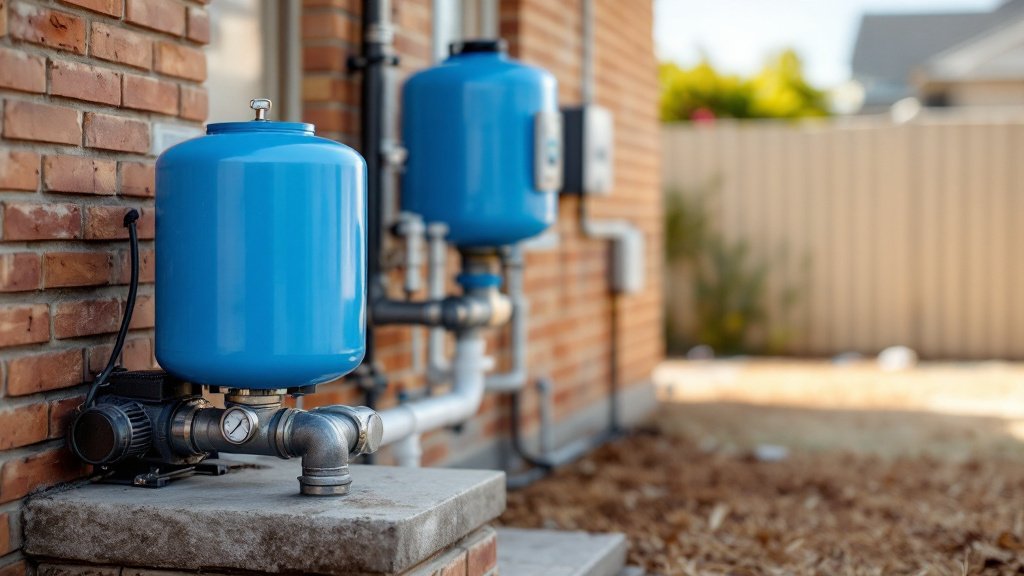
Most pressure systems have a small tank beside the pump, and inside it is a rubber bladder with a cushion of air on one side. That air stores the pressure so the pump can rest between draws. Lose the air and there is nothing left to store it in, so the pump switches on the instant you crack a tap and off again the moment you close it.
Two things go wrong here. The air charge slowly leaks away over the years, which is normal and rechargeable. Or the bladder splits, which is not rechargeable and means a new tank. To tell them apart on a small tank, press the air valve on top with the system switched off and depressurised. A puff of air suggests a charge problem you can top up. Water coming out of the air valve means the bladder has failed.
Do not go hunting for a magic pressure number online. Every tank has its own correct pre-charge, set relative to the pump’s cut-in point. Use the plate on your tank and the pump manufacturer’s instructions, not something you read on a forum.
Leaks bleeding pressure while nothing is running
If the tank checks out, suspect water going somewhere it should not. A healthy system sits still for hours with everything closed. If your pump fires up in the middle of the night with no tap open, something is leaking. Common places to look:
- Toilet cisterns: a worn flush valve trickles quietly and is the most common cause of a pump kicking on overnight.
- Outside taps and garden fittings: a slow weep at a hose fitting or a cracked poly joint will do it.
- The foot valve or non-return valve: if it fails, water drains back down the suction line and the pump loses prime between cycles.
- Buried irrigation lines: a split under mulch or lawn loses plenty without ever showing on the surface.
The simple test is isolation. Shut the valve between the pump and the house and watch the gauge. If pressure holds while the house is isolated but falls once you open it back up, the problem is downstream in the plumbing. If it falls either way, look at the pump, the tank and the non-return valve.
A pressure switch or controller on the way out
The switch tells the pump when to start and stop, and it lives a hard life. Contacts pit and burn over time, and the small sensing port that reads water pressure can silt up or corrode until the switch is reading a fraction of what is really happening. Either fault gives the same symptom: a pump starting and stopping on a hair trigger. Electronic controllers fail their own way, with a sticking flow sensor or a scaled up sensing chamber convincing the unit you are still drawing water when you are not.
Diagnosing a switch properly means working around live terminals, and that is where the job stops being a homeowner one.
What you can safely check yourself
With the pump switched off at the isolation point, you can watch the gauge over an hour to see whether the system holds, walk the property listening for leaks, drop food colouring in each toilet cistern to see whether it seeps into the bowl, look for damp patches around fittings, and read the plate on your tank and pump. Recharging a pressure tank with a bicycle or compressor pump is within reach for a lot of people, but only once the system is isolated and fully depressurised, and only to the figure on the plate.
When to stop and call a licensed trade
Anything involving the pump’s wiring, its terminals, the pressure switch contacts or the supply circuit is electrical work, and in Australia electrical work must be carried out by a licensed electrician. That is not a guideline, it is the law in every state and territory, enforced by the relevant electrical safety regulator. Opening a switch cover to poke at contacts on a live pump is the kind of shortcut that kills people. Leave it and make the call.
If the fix touches your mains connection, potable supply or backflow prevention, that is a licensed plumber’s job under your state plumbing regulator. Garden irrigation on the outlet side is generally fair game, but the moment work joins the drinking water system it needs a plumber.
The good news is that most short cycling comes back to a flat pressure tank or a leaking toilet, and both are cheap to sort. Chase those two first and you will fix most cases before anyone touches a wire.